
1. Introduction
Time is one of the most abstract concepts the human mind struggles to truly grasp. While our brains excel at processing spatial and physical information, they fail structurally at comprehending long time spans — estimating the real distance between life events or appreciating how much time remains in a lifetime. Evolutionary biology explains this cognitive blind spot: accurately modeling distant futures or far-off decades was never a survival necessity for our ancestors, so the brain defaults to focusing on the immediate present, trapping us inside what psychologists call the “temporal bubble.”
The result is a powerful cognitive illusion that makes life feel infinite — an endless stream of tomorrows. This illusion fuels chronic procrastination, causes people to defer their most important goals, and keeps them drowning in trivial daily concerns while years slip by unnoticed.
This is where the Life Progress Bar emerges as a potent cognitive intervention. By translating abstract time into precise, measurable visual data — activating the brain’s spatial processing systems — it delivers an instant, intuitive understanding of how much time has passed versus how much remains. It is not a mere calendar. It is an integrated system that fuses demographic statistics, ancient Stoic philosophy, and modern behavioral neuroscience to create a state of deep awareness known as Mortality Salience — the conscious recognition that life is finite.
Through this visual awareness, individuals gain an extraordinary ability to filter decisions from social pressures, focus transparently on goals that truly matter, and transform the fear of an ending into a powerful engine for productivity and intentional living.
See your life as a percentage. Enter your birth year and visualize how much time you've lived — and how much remains.
2. What Is a Life Progress Bar?
A life progress bar is an interactive graphical representation that maps an entire human lifespan onto a single visual interface — displaying the time a person has lived and the time remaining as a percentage or as discrete time blocks. The concept gained widespread cultural momentum through writer and thinker Tim Urban and his analytical blog Wait But Why, where he introduced the model “Your Life in Weeks.”
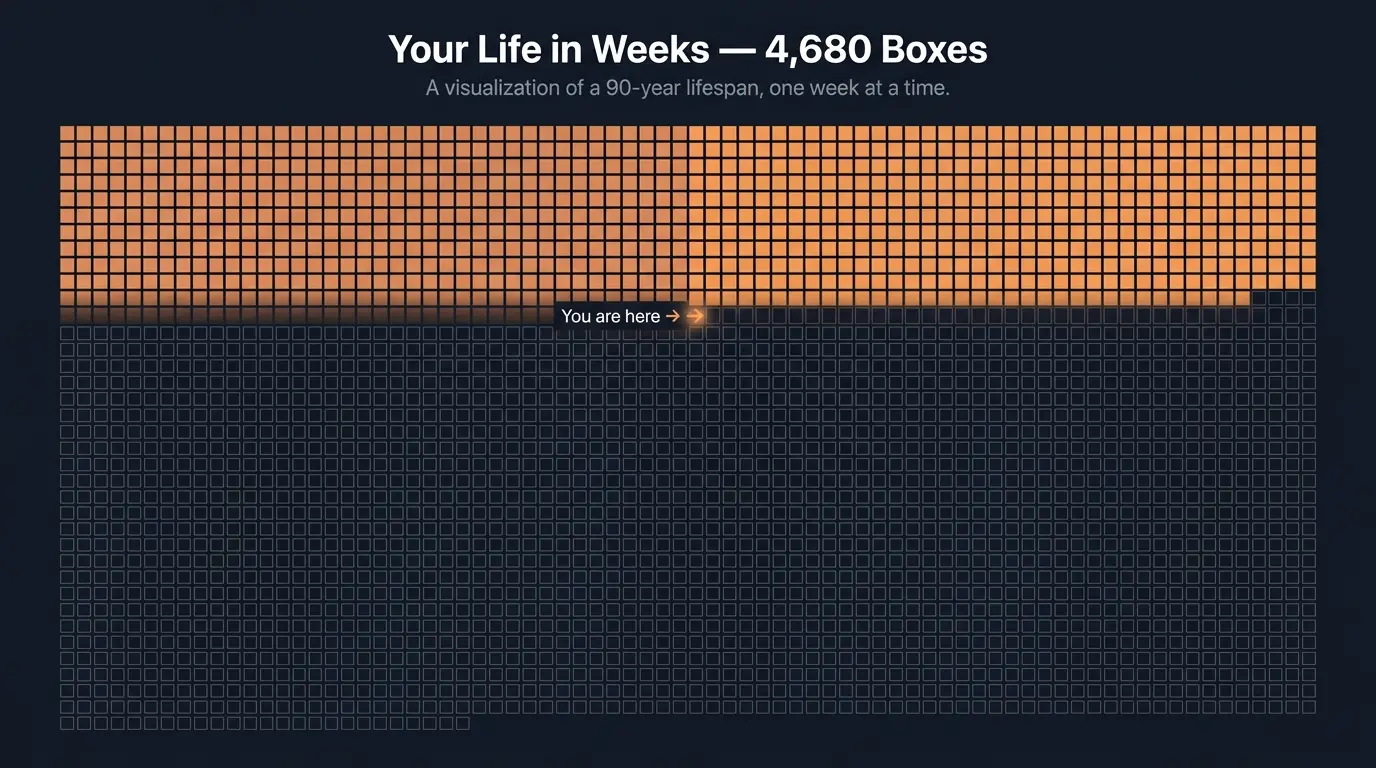
The model rests on a simple yet startling statistical fact: assuming an optimistic average lifespan of 90 years, an entire human life consists of only 4,680 weeks.
These weeks are visualized as a geometric grid — each row represents one year containing 52 small boxes, allowing an entire life to be printed on a single page. Each empty box is a week that hasn’t arrived yet; each filled box is a week already spent. The psychological analysis of this model suggests imagining each week as a tiny 0.05-carat diamond. Collecting all the diamonds representing 90 years would fill nothing more than a single tablespoon.
This visual representation produces a profound psychological impact known as the “Overview Effect” — it forces the individual to confront the finite nature of their time resources and asks an urgent question: how should these rare diamonds be spent — in momentary enjoyment, or in building something meaningful?
With technological advancement, this idea evolved from static paper graphics into sophisticated interactive software applications for smartphones and personal computers. These apps use reactive architectures to continuously update the progress percentage in real time, transforming life progress into a visual loading bar that decreases with each passing moment. By removing the ambiguity of time and replacing it with precise visual data that shrinks continuously, the life progress bar becomes a motivational instrument that frees individuals from temporal “contextlessness” and drives them toward decisive action with a healthy sense of urgency.
3. Life Expectancy Calculator
The scientific accuracy of digital life progress bars depends on the ability to define where the progress bar “ends.” To achieve this, life expectancy calculators rely on complex mathematical models and sophisticated actuarial tables used in population sciences and the insurance industry to estimate the probability that an individual will survive to a given age — based on quantitative analysis of health and demographic variables.
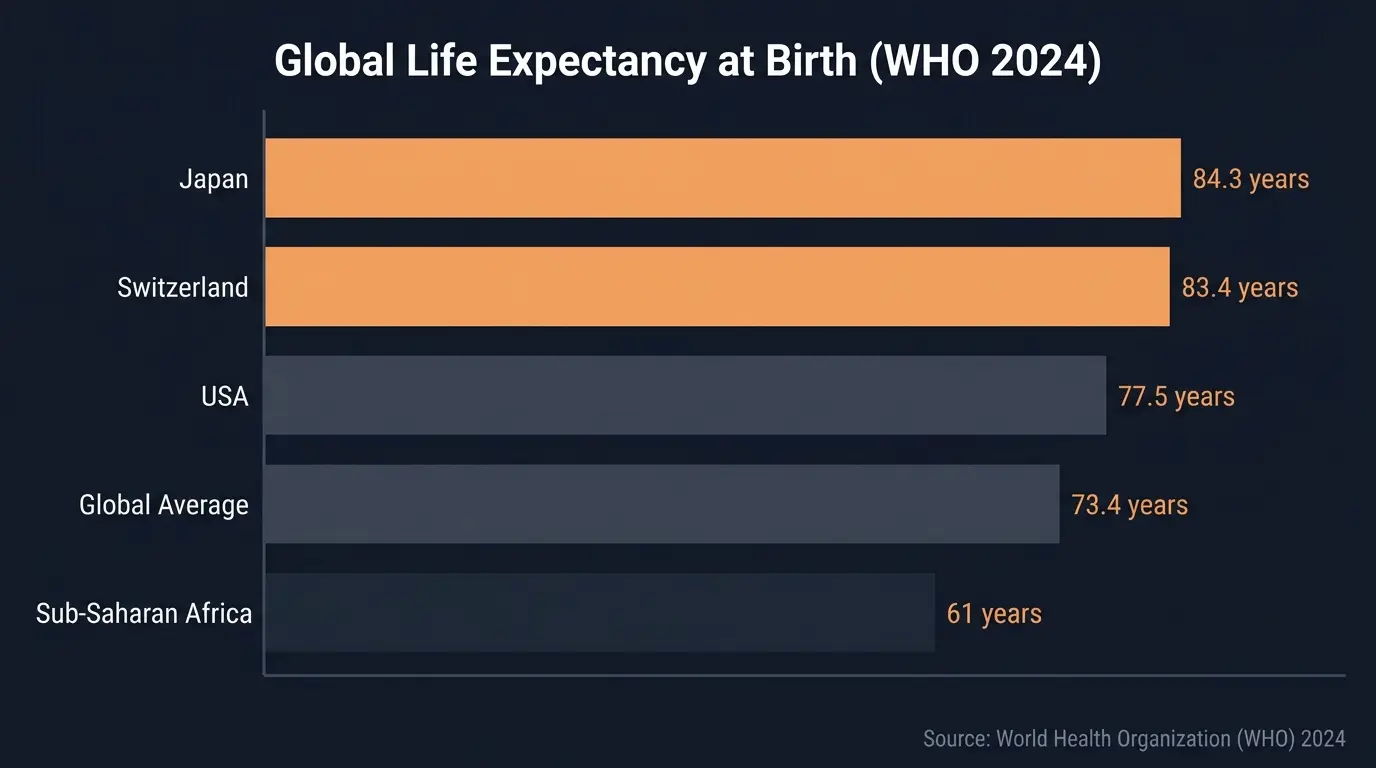
The foundational “Life Tables” are built by authoritative organizations such as the U.S. Social Security Administration (SSA) and the World Health Organization (WHO). These tables track a hypothetical population cohort (typically 100,000 people born simultaneously) and calculate precise mortality rates across every age bracket.
Key Actuarial Variables
| Variable | Definition |
|---|---|
| q(x) | Probability that a person aged exactly x dies before reaching age x+1 — the foundation for all other calculations |
| l(x) | Number of survivors reaching age x from the original 100,000 cohort |
| d(x) | Total deaths occurring within the cohort between age x and x+1 |
| L(x) & T(x) | Total “person-years” lived between age intervals — used to calculate the final average |
| e(x) | Expected remaining years of life for someone at age x — the number apps use to set the bar’s endpoint |
Period vs. Cohort Tables
Actuarial methodologies split into two approaches that significantly affect prediction accuracy:
Period Life Tables take a fixed snapshot of current mortality rates for a single year and assume they continue unchanged — simpler but less personalized.
Cohort Life Tables are more complex and accurate for personal planning. They factor in projected medical and technological improvements that a generation will experience as they age. For example, a cohort table might show that a 65-year-old man has not only an expected lifespan of 88 years, but also a 25% probability of living to 93 — requiring fundamentally different financial and psychological planning.
Advanced calculators (like those used by insurance companies such as John Hancock) integrate individual biometric and behavioral measurements — adjusting the mortality rate q(x) based on blood pressure, cholesterol levels, exercise frequency, alcohol consumption, and even driving records — to generate a highly personalized life expectancy estimate that reflects the user’s actual lifestyle.
📚 Your life contains roughly 4,000 weeks. Oliver Burkeman’s Four Thousand Weeks: Time Management for Mortals reframes productivity around this brutal truth — the most important time management book of the decade. (Paperback, ~$13)
4. Memento Mori Philosophy
The life progress bar is not merely a modern technological invention — it is a digital extension of a philosophical and cultural tradition embedded deep in human history, known as the practice of “Memento Mori” — a Latin phrase meaning “Remember that you will die.”
The tradition originates in the Roman Empire. Historical accounts describe victorious generals returning from battle accompanied by a servant standing behind them in the triumphal chariot, whose sole task was to repeat this phrase in their ears — preventing hubris and reminding them that human glory, however great, is fleeting and temporary.
The Stoic Foundation
The philosophy crystallized through the Stoic philosophers, who considered continuous contemplation of death a practical tool for liberating the mind from superficial fears and directing behavior toward virtue.
Emperor Marcus Aurelius wrote in his Meditations: “You could leave life right now. Let that determine what you do and say and think.” Seneca urged treating each day as if it were the last, arguing that daily life auditing prevents the accumulation of regret and ensures one never feels a shortage of time.
The Stoic goal was never to inspire depression or nihilism — but to strip death of its paralyzing mystique and use it as a mechanism for generating courage, gratitude, and awareness of the present moment.
Visual Traditions Through History
| Era | Expression | Purpose |
|---|---|---|
| Late Middle Ages | Danse Macabre (Death’s Dance) art | Death depicted as an equalizer leading kings, peasants, and popes alike |
| Dutch Golden Age (17th c.) | Vanitas still-life paintings — skulls, hourglasses, wilting flowers | Visual warnings against attachment to material wealth |
| Victorian Era | Mourning Rings worn by all social classes | Maintaining constant awareness of life’s fragility |
| Modern Era | Physical Memento Mori coins, digital life progress bars | Tactical anchors that cut through digital noise |
In the modern age of constant connectivity and infinite distractions, memento mori is experiencing a renewed renaissance as a productivity and mindfulness system. Business leaders and thinkers carry physical coins stamped with death symbols (such as those from Daily Stoic) as tactical anchors in their pockets. When touched — or when a digital life progress bar is seen — it acts as a “reality filter” that cuts through confusing social expectations, helping individuals discard trivial tasks, stop worrying about others’ opinions, and refocus energy on the “vital few” goals worth pursuing.
📚 The original Stoic text on mortality awareness. Marcus Aurelius’ Meditations has guided leaders for 2,000 years — the most practical philosophy book ever written. (Paperback, ~$7)
5. Psychology of Visualization
The impact of watching life shrink as a percentage bar extends far beyond philosophy — it rests on solid foundations in cognitive psychology and behavioral neuroscience, specifically in understanding how the human mind responds to mortality awareness triggers.
Terror Management Theory (TMT)
Terror Management Theory, inspired by anthropologist Ernest Becker’s work, provides the most prominent explanation. The theory posits that human behavior is governed by a fundamental psychological conflict between the biologically rooted survival instinct and the uniquely human cognitive awareness of inevitable death — producing deep existential anxiety.
When exposed to Mortality Salience (death awareness pushed to the forefront of consciousness via tools like life progress bars), the brain activates two types of psychological defenses:
- Proximal Defenses: Immediate denial and distraction — pushing the threat away
- Distal Defenses (more powerful long-term): Driving individuals to cling to cultural worldviews that give life meaning, and pursuing self-esteem as a form of symbolic immortality through achievements and legacy
Functional MRI (fMRI) research shows that mortality salience activation increases activity in the prefrontal cortex (responsible for self-regulation and decision-making) and the right amygdala (emotional processing) — redirecting cognitive focus entirely.
Future Self-Continuity
Another critical explanation is the concept of “Future Self-Continuity.” Psychological and neurological studies have demonstrated that the human brain often treats its “future self” as a complete stranger. Brain activity measurements show a notable decrease in the rostral anterior cingulate cortex (rACC) when individuals think about their future selves compared to their present selves.
This “neural distancing” explains the human tendency to make decisions that harm the future — chronic procrastination, poor financial planning, and preferring immediate rewards (a phenomenon called Temporal Discounting).
Life progress bars serve as a visual intervention: by representing the continuous timeline, they shrink this psychological distance, concretely linking present identity with future identity. Research shows that individuals exposed to visual representations connecting them to their future selves make wiser decisions — increasing financial savings, improving health behaviors, and reducing procrastination.
The Fresh Start Effect
Temporal Landmarks play a crucial role. The week and year boundaries in a life grid act as psychological break points that activate the “Fresh Start Effect.” These landmarks psychologically separate individuals from past failures, reduce the cognitive burden of wrong decisions, and enhance the Big Picture view of life — boosting motivation to adopt ambitious goals and attempt self-discipline with each new empty box representing a fresh week.
6. Life Tracker Features
Modern technology has leveraged psychological theories and Stoic philosophy to develop specialized software tools that translate the abstraction of time into interactive visual data. Digital applications like Lifetime, Life in Percent, and IRL Health Bar offer sophisticated analytical features:
Life Weeks Calendar: The core feature of most life tracking tools, inspired by Wait But Why models. The interface displays the user’s age as a grid of dots or squares — each representing one week of total life expectancy. Lived weeks are shaded; future weeks remain empty — delivering an instant visual punch of how much time remains.
Progress Bars and Percentages: Instead of grids, some interfaces use interactive progress lines — similar to file download bars — showing the exact percentage of life lived to this moment and the percentage remaining, based on the user’s actuarial calculations.
Health Metrics Integration: Advanced apps go beyond time measurement by integrating biological rhythms through wearable devices and smartwatches. Health bars track live biometric indicators — heart rate, heart rate variability (HRV), sleep cycles, and calories — presenting them as a “health bar” that mimics video game energy bars, reflecting the body’s actual vitality.
Biological Milestones: Specific apps provide astonishing biological statistics — real-time calculations of the estimated total heartbeats the user’s heart has produced and total breaths taken since birth, based on metabolic rate algorithms.
Home Screen Widgets: To ensure continuous awareness, apps provide widgets pinned to the phone’s home screen, delivering live, persistent updates on time statistics (remaining days, weeks, and years) and sending gentle notifications reminding the individual of today’s progress as a percentage — creating a daily memento mori that interrupts passive digital consumption.
7. Behavior Changes
Systematic exposure to end-of-life reminders through life progress bars doesn’t remain confined to philosophy — it produces powerful interventions in concrete behavioral patterns. Advanced research on the Terror Management Health Model (TMHM) and mortality salience effects demonstrates that directed awareness of finitude can steer behavior toward preventive and altruistic trajectories.
Health Habit Modification
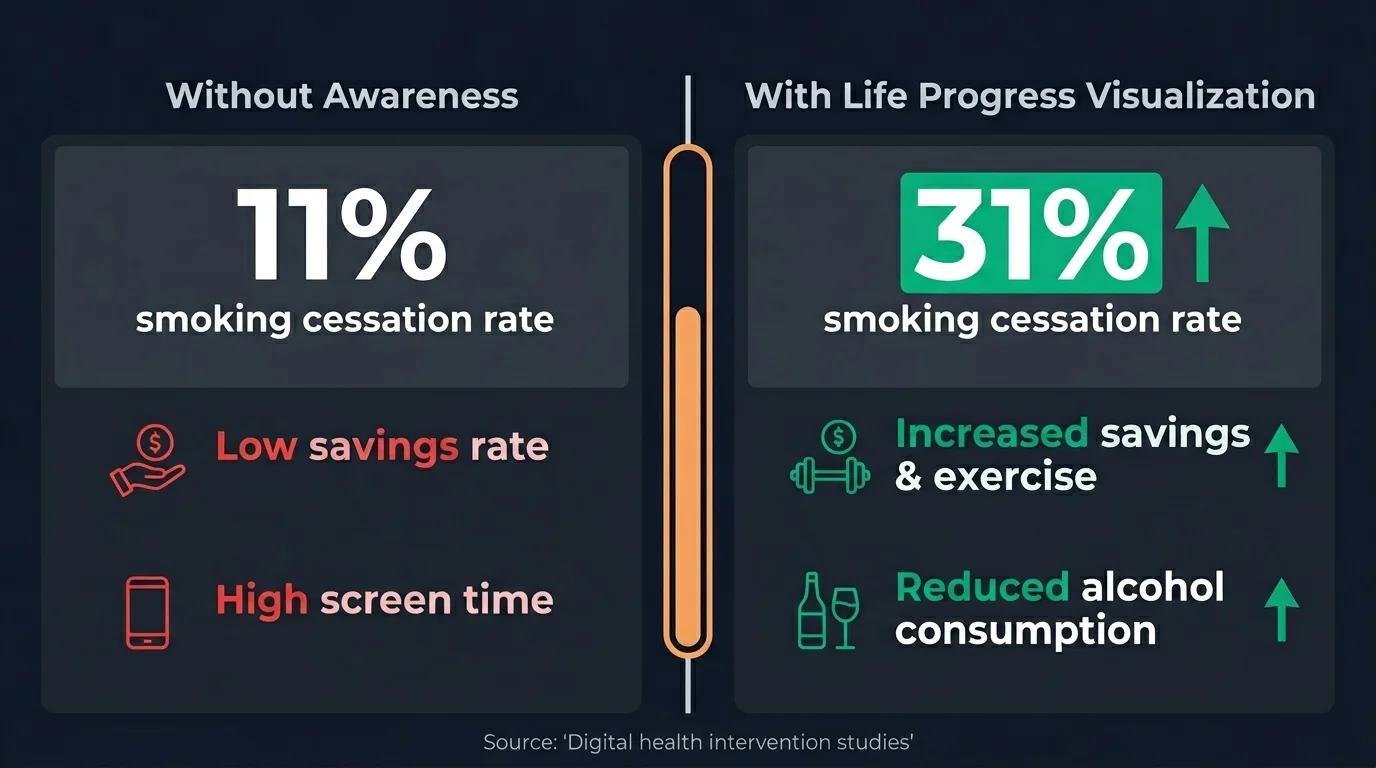
One of the most prominent behavioral changes is modification of destructive health habits — smoking cessation and addiction recovery. Recent studies supported by digital interventions using future-self visualization found that mortality awareness, combined with personal planning tools, drives higher levels of health commitment.
A digital health program targeting young smokers showed that participants receiving personalized visual interventions enhancing future awareness achieved smoking cessation rates of 31%, compared to only 11% in control groups. This awareness also triggered concurrent positive effects — increased exercise days and reduced alcohol consumption — because awareness of time limitation lowered the attractiveness of unhealthy instant gratification in favor of long-term survival.
Psychological and Social Impact
Death reminders don’t necessarily trigger negative defensive responses or self-isolation. Studies indicate that “Death Reflection” (which differs from momentary Death Anxiety) enhances intrinsic motivations. In scenarios simulating resource allocation and economic decision-making, individuals who practiced conscious introspection about their mortality showed sharp decreases in material greed and excessive consumption, replacing them with deeper engagement in goals focused on personal growth.
The behavioral effect extends to enhancing prosocial behavior — altruism and community engagement. Data from major health crises showed that mortality awareness, when combined with reflective thinking and a sense of global identity, led to notable increases in willingness to help others, volunteer, and adopt collective preventive behaviors — viewing these altruistic acts as psychological defense mechanisms that give their limited lives sustainable meaning beyond their biological lifespan.
8. Self Improvement Integration
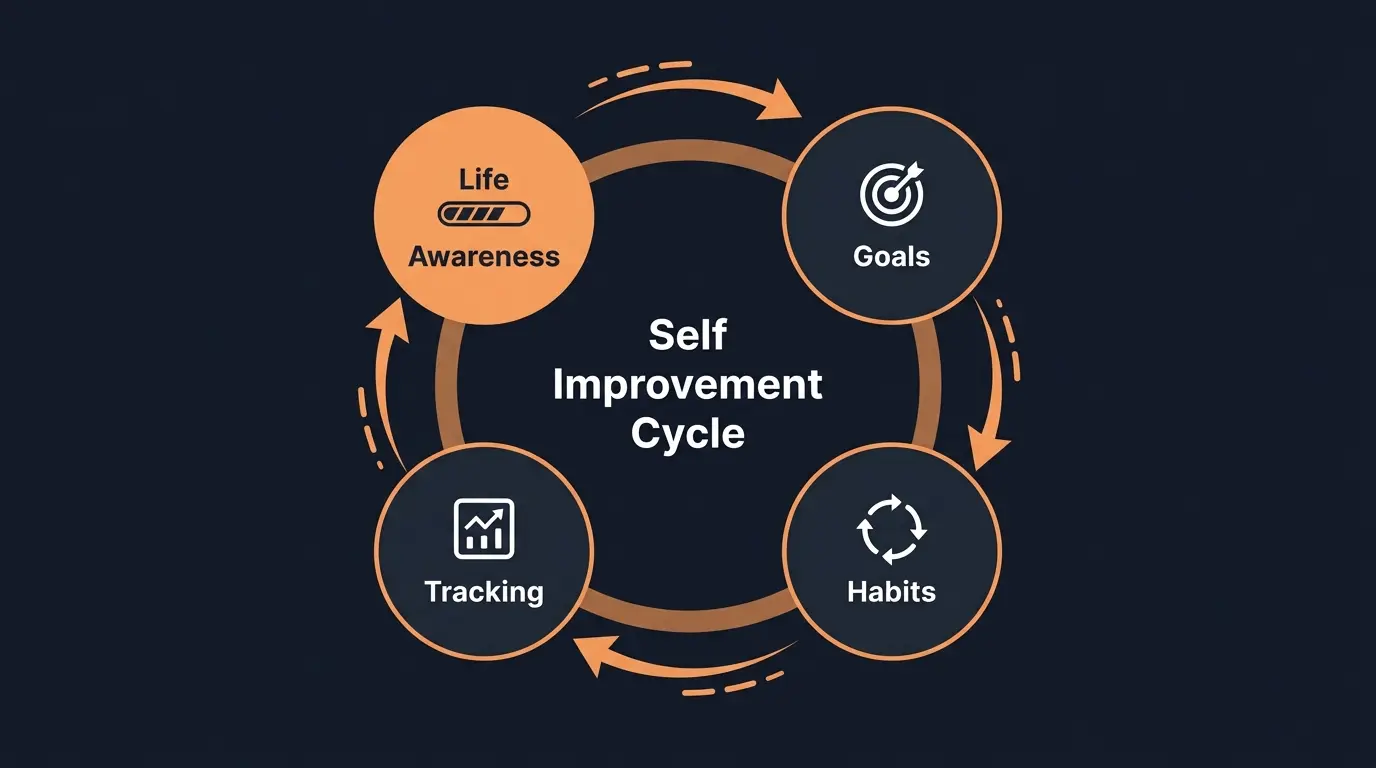
To ensure that staring at a shrinking time bar doesn’t become a source of anxiety or analytical paralysis, it’s essential to integrate this existential awareness into daily self-improvement systems. This integration leverages the urgency generated by life visualization to dismantle systematic procrastination and refine core goals.
The Procrastination Problem
Tim Urban’s analysis of procrastination psychology describes the human mind as containing a “Rational Decision-Maker” who plans for the future, and an “Instant Gratification Monkey” who constantly seeks easy, comfortable pleasure in the present moment while ignoring future consequences. Procrastinators live in what Urban calls the “Dark Playground” — enjoying unjustified leisure.
The only entity capable of scaring the monkey and reclaiming control is the “Panic Monster” — which remains asleep until major project deadlines approach dangerously. The problem: life’s biggest goals — building a family, writing a novel, preserving health — have no externally imposed deadlines, keeping the Panic Monster in deep slumber and allowing precious years to waste in procrastination corridors.
This is where the life progress bar shines. It functions as a permanent, visible Panic Monster — providing an objective deadline for the individual’s entire existence, banishing the Instant Gratification Monkey and creating a motivating environment for immediate action.
The Reality Filter
The life progress bar also acts as a strict “Reality Filter” that directs the self-improvement compass toward genuine values. Through mental exercises paired with death visualization — such as the “90-Year-Old Test” (imagining yourself at 90, looking back at what truly mattered) or filtering decisions through: “On my deathbed, will I regret not doing this, or will I regret what I sacrificed for it?” — this rigorous perspective eliminates tolerance for unproductive meetings, stops the cycle of excessive wealth pursuit beyond sufficiency, and encourages exclusive focus on the “vital few” tasks: deep health, family legacy, or a professional contribution that extends beyond one’s absence.
📚 Building lasting habits is the bridge between awareness and action. James Clear’s Atomic Habits provides the system for turning life progress insights into daily behavioral change — the #1 habit book worldwide. (Paperback, ~$12)
9. Personal Growth Planning
Strategic personal growth planning is the practical step that converts the shock of life progress bar awareness into a consistent, measurable trajectory. Management psychology and design thinking offer methodological frameworks to organize this path and reduce uncertainty anxiety.
The Life Audit
The process begins with a “Life Audit” — a comprehensive, systematic evaluation resembling financial audits. It targets analyzing all aspects of current life and breaking them into core categories: career development, financial stability, physical and mental health, family and social connections, and continuous learning. The individual assigns a numerical rating (1–10) to each category representing current satisfaction. This visualization immediately reveals gaps and imbalances — such as realizing all energy is being consumed by career while health or relationships are dangerously neglected — paving the way for priority adjustment.
The 5-Year Plan
The most practical timeframe is the “5-Year Plan.” Rather than drowning in attempting to visualize an entire life path or focusing on scattered daily decisions, the five-year plan serves as a strategic bridge converting abstract future visions into measurable milestone steps. This framework provides a motivational compass that alleviates the paralysis caused by fear of future failure, while maintaining enough flexibility to adapt to unexpected changes.
Odyssey Planning (Stanford Life Design Lab)
At a more innovative level, “Odyssey Planning” — developed by the Stanford Life Design Lab — borrows Design Thinking tools from product engineering and applies them to an individual’s life path. This approach requires the individual to document and visually map three different future scenarios for the next five years:
- Plan A — “The Intuitive Plan”: The logical path and natural extension of the current trajectory
- Plan B — “The Pivot Plan”: The alternative path the individual would immediately pursue if Plan A collapsed or their field disappeared
- Plan C — “The Wild Card”: The radical, passionate path representing true desire — pursued if all financial constraints and social criticism risks were removed
Each path is designed with a graphic timeline including non-career events like health and hobbies, followed by a “Prototyping” phase to test parts of these plans practically before full commitment — granting extraordinary flexibility in engineering one’s time icons on the life progress bar.
10. Life Planning Tool
Executing complex growth strategies and managing them effectively requires digital infrastructure that goes beyond merely displaying numbers — transforming into an integrated work environment capable of synchronizing data, managing tasks, and displaying progress bars.
Spreadsheet-Based Systems: Spreadsheets provide the most flexible environment for implementing the “Life in Weeks” vision. Engineers like Felix Krause have designed free templates on platforms like Google Sheets (known as LifeOverview), allowing users to draw their complete life grid with advanced color-coding strategies — one color for education years, another for work periods, and colors representing unemployment or travel. This topographic map also allows writing brief notes within week cells to link major events to the visual timeline.
Task Management Dashboards: A Personal Life Dashboard serves as a command center integrating scattered data into a single comprehensible visual interface. Applications like Reclaim.ai, Todoist, and ClickUp offer capabilities for creating dashboards that import goals, key metrics, and habit tracking data in real-time. These dashboards can automate Time Blocking on calendars and provide mind maps for organizing complex thoughts.
Notion Templates: Platforms like Notion have revolutionized life organization by allowing users to build relational databases and design custom tracking systems without writing code. Notion’s environment offers templates specifically designed for goal tracking with advanced features — including automatically generated progress bars based on mathematical formulas. Users program a simple formula calculating the difference between “initial state,” “current state,” and “final target,” and the tool produces a graphical bar that fills with each partial achievement, accompanied by smart status labels that automatically determine whether a goal’s trajectory is behind or ahead of schedule.
Enter your birth year, select your region, and instantly visualize your life progress — with weekly grid, percentage bar, and biological statistics.
11. Dream Life Visualization
Life planning isn’t limited to tracking numbers and quantitative data — at its core, it relies on the cognitive power of “Dream Life Visualization.” Anticipatory visualization is an advanced mechanism that uses directed imagination to construct a rich, clear mental picture of an ideal future — whether in career development, relationships, health, or inner peace. It connects the urgency generated by a shrinking life progress bar with a positive, attractive target worth pursuing.
This effect has genuine neurological foundations beyond abstract positive thinking. Studies have demonstrated that continuous visualization activates the Reticular Activating System (RAS) located in the brainstem. This system acts as a gatekeeper filter, screening billions of sensory data points the individual is exposed to daily, allowing only information relevant to their deep priorities to pass through. When the brain is trained through visual imagery of a desired life, it programs the RAS to capture opportunities, resources, and subtle environmental details aligned with those goals that would otherwise be completely ignored — making attention laser-directed toward achieving the vision.
Practical Implementation
Vision Boards are among the most powerful embodiment tools — whether in traditional physical form (magazine clippings and printed photos) or digital format (using apps like Canva or Pinterest). Boards arrange expressive images and inspiring words in a single visual space, placed where they can be seen daily to keep goals alive in direct awareness.
Guided Visualization and Deep Imagery relies on systematic meditative journeys targeting emotional connection with the envisioned future self — such as living in a state of gratitude for a future success that hasn’t yet occurred. Regular practice strengthens positive neural pathways, overcomes internal resistance, and weakens limiting negative beliefs, preparing the subconscious to work in harmony with the plan.
12. Life Stats & Analytics
Incorporating analytical statistics and time-use surveys alongside the progress bar provides a powerful reference for understanding the reality of time expenditure. Based on the premise that humans live approximately 79 years on average — translating to about 28,854 days or 692,496 hours — collective behavior analysis reveals numbers that demand a lifestyle reassessment.
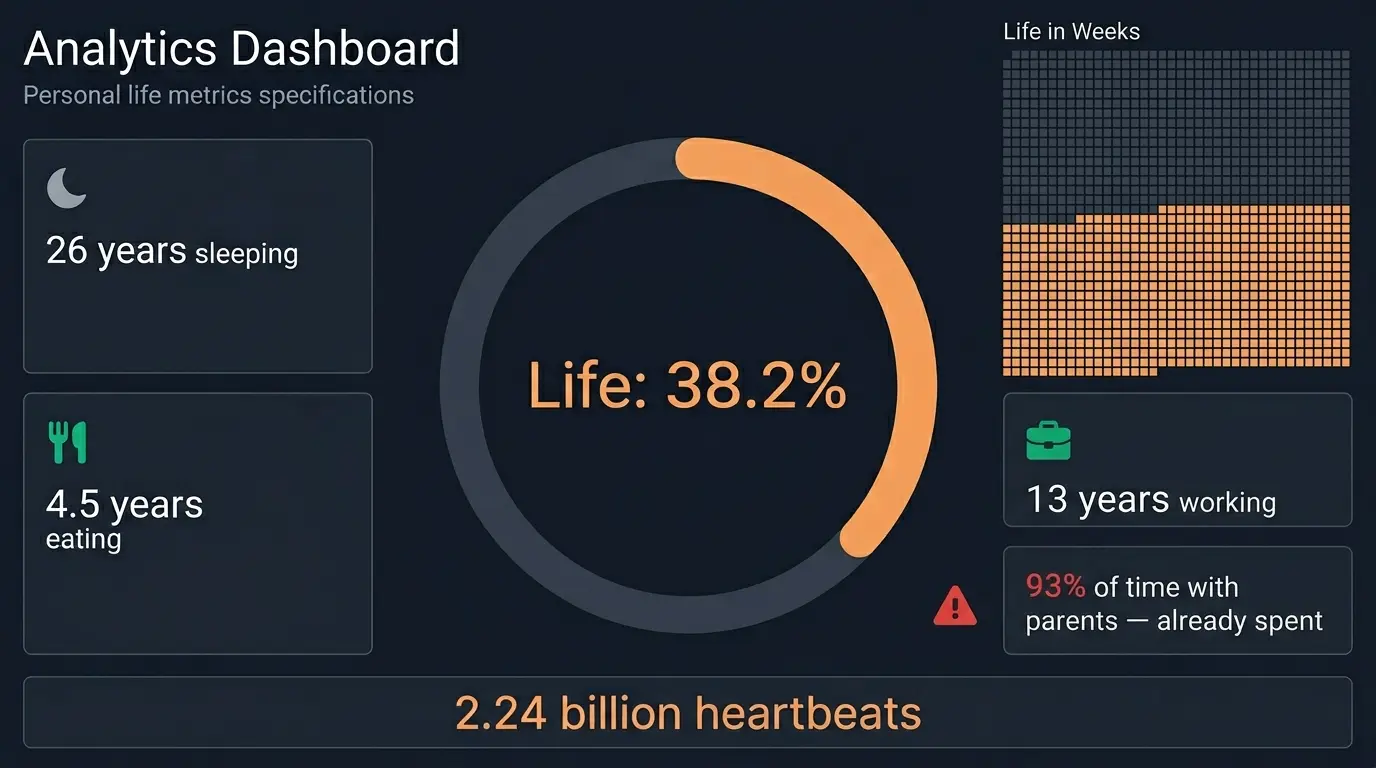
The American Time Use Survey (ATUS) reveals that the largest portion of life is consumed by basic needs:
| Daily Activity | Average Time | Lifetime Impact |
|---|---|---|
| Sleep | 9.07 hours/day | ~26 years sleeping + 7 years trying to fall asleep |
| Leisure/Entertainment | 5.15 hours/day | TV alone consumes 2.67 hours/day on average |
| Work (full-time) | 8.1–8.4 hours (weekdays) | Consumes the majority of waking hours for working-age adults |
The Tail End — Relationships
These statistics gain an emotionally devastating dimension when viewed through Tim Urban’s famous “The Tail End” analysis of social relationships. The analysis reveals that time spent with loved ones doesn’t follow a linear path across life — it concentrates heavily in the early years then drops sharply:
- Time with parents: By high school graduation (~age 18), you’ve already consumed approximately 93% of total face-to-face time with your parents. A 35-year-old is living in the final 5%.
- Time with siblings and childhood friends: After geographic separation, only ~15% of cumulative sibling time remains. Only ~7% of total time with high school friends remains.
The Billion-Heartbeat Rule
On a purely biological level, statistics provide a precise measure of life’s pace. According to observations related to Kleiber’s Law and the rate-of-living theory, most mammals (whether mice or elephants) share a cosmic allotment of approximately 1 billion heartbeats across their natural lifespan. Humans are the sole biological exception — thanks to modern medicine, food preservation, and water quality improvements, the human heart exceeds this natural limit to average more than 2.24 billion heartbeats — highlighting the evolutionary privilege and the extraordinary opportunity to leverage this bonus time.
13. Life Tracking Journal
The practice of tracking and periodic review is a fundamental pillar for preventing time awareness from fading amid daily distractions. The Life Tracking Journal serves as a structural mediator enabling individuals to introspect on progress, record emotional changes, and practice periodic self-accountability.
Physical vs. Digital Journals
Physical (paper) journals create a strong neurological bond between hand and mind — the Hand-to-Mind Connection. This kinesthetic link slows thinking speed and allows processing of complex, deep emotions in a raw way, free from the distracting auto-corrections and formatting of devices. Over time, these notebooks become tangible time capsules reflecting the individual’s legacy and growth.
Digital journals (via apps or advanced Notion templates) offer enormous flexibility in terms of access, navigation, and data encryption. Digital journaling enables rapid capture of ideas at the moment of inspiration from anywhere, plus automatic search and archival capabilities — making it a practical choice for the fast pace of modern life.
Memento Mori Journal Structure
Advanced journals, especially those inspired by Memento Mori philosophy, provide daily structural guidance:
Philosophical Opening Quotes: Daily entries guided by original Stoic texts (such as Aurelius’ Meditations or Seneca’s Letters), used to prime the mindset and direct contemplation toward disciplined acceptance and perseverance.
Growth Prompts: Deep questions designed to challenge the status quo and explore core motivations. Examples:
- “What beliefs or expectations am I clinging to that no longer align with who I aspire to be?”
- “If I fully trusted myself, what difficult decision would I make immediately before fear constrains it?”
- “If this were my last week on earth, what would I do differently?”
Daily Examen: An ancient practice of critical self-review performed at day’s end — focusing on recording gratitude, reviewing behavior alignment with goals, and setting a clear improvement intention for the next day.
📚 The physical practice of journaling compounds over time. A structured Clever Fox Planner PRO with weekly reviews and monthly reflections turns awareness into measurable progress — the top-rated life planner on Amazon. (Hardcover, ~$25)
14. Using the Tool
Knowing theoretical concepts isn’t enough — the life progress bar requires adopting effective practical habits to transform it from a philosophical idea into a functional “operating system” that guides daily behavior and measures efficiency periodically.
Color-Coding and Weekly Introspection: Use a life weeks grid (whether printed as a large wall poster or as a digital spreadsheet template) and assign a specific color to each box representing a completed week, based on qualitative assessment: green for an exceptionally positive week, blue for a satisfying/productive week, orange for a stressful week, and red for a failed week. This system forces a dedicated five-minute Sunday evening session to review the week — celebrating successes, identifying obstacles, and planning a different approach for the new week.
Avoiding “NeitherLand”: The effective use involves classifying how diamonds (weeks) are spent in two primary tracks: either the week is used for “present enjoyment” (good entertainment and living), or it is invested in “building the future” (work, career, and personal growth). The tool reveals weeks belonging to neither track — a space called “NeitherLand” — where time is wasted on activities that bring neither happiness nor build a better future. Seeing consecutive wasted boxes creates immediate corrective momentum.
Milestone Plotting: Instead of serving merely as a historical record, use the grid as a strategic planning board. Mark future boxes with landmarks indicating key milestones — such as completing a degree or changing career paths. This representation provides a literal view of how many weeks remain to achieve the goal, undermining procrastination and raising tactical achievement pace.
Enter your birth year and see your life as a percentage, a weekly grid, and raw statistics. Free, private, no account required.
15. Frequently Asked Questions
What is a “Life Progress Bar”?
A visual, interactive representation that replaces the abstract concept of time by converting a person’s expected lifespan into an increasing percentage, or a grid of boxes where each box represents one week. It’s designed to clarify exactly how much time has been consumed and how much remains — pushing individuals to break the cycle of permanent postponement.
How many weeks does a 90-year life contain?
Assuming a long, healthy lifespan of 90 years, life consists of only 4,680 weeks. Seeing this finite number printed as boxes makes life feel measurable and profoundly limited.
What is “Memento Mori” and how does it relate?
Latin for “Remember that you will die.” It’s an ancient Stoic philosophical practice of keeping mortality awareness present in daily consciousness. Rather than inspiring fear, it’s used as a powerful tool for stripping social pressure from decisions, evaluating what truly matters, and eliminating trivialities.
How do Life Expectancy Calculators work?
They rely on complex actuarial tables (such as those from SSA and WHO). Simple calculators use gender and birth date for statistical averages. Advanced ones incorporate biometric assessments — blood pressure, weight, smoking status, driving records — to calculate a personalized mortality rate.
Does frequent thinking about death cause depression?
According to Terror Management Theory, death awareness causes initial anxiety. But when directed toward “Death Reflection” (rather than abstract anxiety), it triggers positive psychological defenses — personal growth, reduced materialism, increased altruism, and deeper meaning-seeking.
What is “Future Self-Continuity”?
The degree to which an individual feels emotionally and neurologically connected to their future self. The brain sometimes treats the future self as a stranger. Progress bars help shrink this psychological distance, leading to better savings, health decisions, and reduced temporal discounting.
What is the “Fresh Start Effect”?
A psychological phenomenon where individuals treat periodic time landmarks (weekly, monthly, yearly boundaries) as psychological break points from past failures. Life grids divided into weeks give individuals a permanent opportunity to use each new empty box as a fresh commitment point.
What are “The Tail End” statistics about relationships?
By age 18, you’ve consumed ~93% of face-to-face time with your parents. Only ~15% of sibling time and ~7% of high school friend time remain. These statistics highlight the urgent need to reprioritize relationships and invest in quality time with family.
How does a life progress bar help with smoking cessation?
Digital interventions combining mortality awareness with future-self visualization showed 31% cessation rates vs. 11% in control groups. The awareness also reduced alcohol consumption and increased exercise days.
How many heartbeats does the average human get?
Most mammals receive roughly 1 billion heartbeats over their natural lifespan (Kleiber’s Law). Humans are the sole exception — modern medicine extends the human heart to over 2.24 billion heartbeats on average.
What is “Odyssey Planning”?
A life design framework developed at Stanford requiring three different five-year scenario maps: Plan A (current trajectory), Plan B (pivot alternative), and Plan C (the passionate wild card path without financial constraints). It provides flexibility to test scenarios before full commitment.
How does the Reticular Activating System (RAS) support dream visualization?
The RAS in the brainstem filters billions of sensory data points daily. When trained through vision boards and positive visualization, it’s programmed to detect opportunities and environmental details aligned with your goals — making attention laser-directed toward achieving your vision.
What is “NeitherLand” in the context of time tracking?
Weeks spent on activities that bring neither happiness nor build a better future. The life grid reveals these wasted weeks as empty, purposeless boxes — creating immediate corrective motivation to escape this unproductive zone.
What format works better for life journaling — paper or digital?
Paper journals create a stronger hand-to-mind neurological connection and serve as tangible time capsules. Digital journals offer speed, searchability, and encryption. The best approach: use both — paper for deep weekly reflection, digital for daily rapid capture.
Why are Health Metrics important in modern life progress apps?
Life progress isn’t just about days decreasing — it’s affected by bodily vitality. Advanced apps integrate live biometric data like HRV (heart rate variability) from smartwatches to diagnose stress periods, determine actual daily energy levels, and calibrate effort to avoid burnout and ensure long-term health.
16. Conclusion
The deep analysis of the life progress bar concept reveals that it transcends being a mere graphical interface or a clever app for counting days. It represents a high-precision psychological and philosophical intervention designed to restructure human perception of time.
By bridging the ancient wisdom of the Stoics in practicing memento mori with the mathematical complexity of actuarial models, extending to “quantified self” applications integrated with wearable device algorithms, the progress bar provides a powerful visual platform that dismantles the cognitive illusion portraying life as an infinite extension.
Evidence from behavioral neuroscience and psychological studies confirms that visually converting abstract time into tangible boxes — filled and colored based on achievement assessment — vitally contributes to bridging the gap between present identity and future self (Future Self-Continuity). This process breaks chronic procrastination barriers, awakens the productive Panic Monster to counter negative instant gratification, and proves that introspective awareness of temporal and biological limits doesn’t produce existential terror but activates positive Death Reflection — clarifying priorities and stimulating behaviors that are more altruistic, healthier, and more goal-oriented.
The purpose of this rigorous life visualization is not to count remaining weeks with fear, but to provide a data-driven strategic roadmap enabling individuals to apply advanced methodologies like Life Auditing and Odyssey Planning — ensuring days are never spent in “NeitherLand.” The life progress bar stands as an inevitable witness and precise compass, calling for every temporal diamond to be invested with full awareness and courage — building a deeply meaningful legacy and creating a human experience worth living before time runs out.
Complete Your Awareness Library:
| 📚 Book | Why Read It |
|---|---|
| Four Thousand Weeks — Oliver Burkeman | Reframe your relationship with finite time |
| Meditations — Marcus Aurelius | The original Stoic guide to living fully |
| Atomic Habits — James Clear | Turn awareness into daily behavioral change |
Sources & References
- WHO — Life Expectancy and Healthy Life Expectancy Data
- U.S. Social Security Administration — Actuarial Life Tables
- Wait But Why — Your Life in Weeks (Tim Urban)
- Wait But Why — The Tail End
- Terror Management Theory — Empirical Research (NCBI)
- Stanford Life Design Lab — Odyssey Planning
- Bureau of Labor Statistics — American Time Use Survey
- Ernest Becker Foundation — The Denial of Death